Forests
Carolinian Forest
The Carolinian forest refers to a life zone in eastern North America characterized primarily by the predominance of deciduous (broad-leaf) forest. The term "Carolinian", which is most commonly used in Canada, refers to the deciduous forests which span much of the eastern United States from North Carolina northward into southern Ontario, Canada. These deciduous forests in the United States and southern Ontario share many similar characteristics and species, hence their association. Today, the term is often used to refer to the Canadian portion (northern limit) of the deciduous forest region, while the portion in the United States is often referred to as the "Eastern deciduous forest"
Carolinian Canada
The Carolinian forest in Canada is located at the southern tip of Ontario between Lake Erie, Lake Huron and Lake Ontario. The region contains an extremely high biodiversity of species, over 500 of which are considered rare. Research in the Carolinian zone has shown that many rare vascular plants are concentrated on specific landforms and within protected areas, showing the importance of conserving key landscape features of this region.
Lanark Country (including Perth) is part of the Canadian Shield and Great Lakes Basin. Of course to plants and wildlife borders don't mean much and things change with shifting geology, climate and human activity.
Old Growth Forests In Ontario
Prior to European settlement, Ontario and much of Eastern North America was dominated by large tracts of old growth forests. The arrival of European settlement, starting in the 1700’s, led to massive changes in the landscape and forest composition of Eastern North America. Settler activities such as logging, agriculture, and urban development contributed to these changes. Today, remaining old growth forests are few and far in between.
Forests in Cities?
Probably every one of us has memories of some town or city of their childhood that still brings moments of joy because of the trees and green spaces we remember that gave us shade, exploration activities and opportunities to play away from a stuffy house or crowded street with hardly any trees? Do we have that in our current lives? Where have the urban forests of the past gone and can we bring them back? Please click on the button below to get some ideas.
EcoPerth Forest
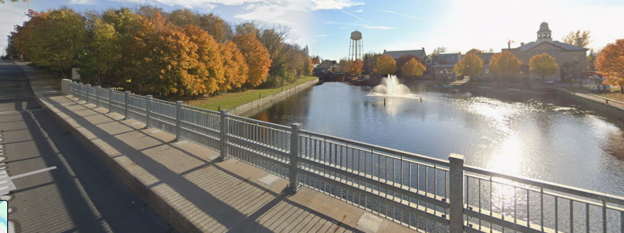
The EcoPerth Forest was started in 2002 when Heritage Perth planted many native trees on a path that ran from Drummond Street East to Gore Street across the Tay Basin from the Crystal Palace and the Mammoth Cheese monumant. This little forest was intended to be as "natural" as possible with minimal human maintenance. It was started long before Our Perth Trees was formed although OPT volunteers have helped clear invasive garlic mustard weed from the undergrowth. OPT is trying to plant and maintain other little forests in parks like Last Duel. More information about the EcoPerth forest was printed on the marker erected at the end of the bridge and can be found by clicking on the button below.
Create Your Own Website With Webador